Your Competitor Is Being Recommended by AI. Here's How to Find Out Why.
September 17, 2026 · 13 min read · AEO Digital

Quick answer
If ChatGPT, Perplexity, or AI platforms recommend your competitor instead of your business, it doesn't necessarily mean they're better. It may mean the AI found stronger or more relevant information connecting that competitor to the specific question. The real opportunity is to find out what information, sources, and associations are helping your competitor appear and where your brand may have gaps.
You ask an AI platform: "Which are the best companies for software development?" The results appear, and your competitor is there, but your company isn't. You try asking the same question again, but in a different version. Once again, the competitor shows up at the top of the results, while your company doesn't appear in the answer.
Does that mean that your competitor provides better software development services than you?
Not necessarily. AI recommendations look at the direct information it can find about a business and how well that information matches the question. The result may indicate that your competitor has clearer or more widely available information about what they do, who they serve, what they're known for, or the services they provide.
So instead of asking, "Why is AI choosing my competitor?", ask: "What information and sources are helping my competitor appear for this question, and what might be missing from our own online presence?" This will help you spot gaps in your online presence and understand what you need to improve.
Let's identify what information, signals, and sources may be helping your competitor appear in those answers.
What Influences AI Business Recommendations?
There is no single formula that determines which business an AI platform will recommend. Different platforms use different models, search systems, data sources, and methods for generating answers. Depending on the platform and query, relevant information may include:
- What a company does
- The products or services it provides
- The customers or industries it serves
- Its geographic coverage
- Its areas of specialization
- The problems it solves
- Its expertise and experience
- How independent and third-party sources describe it
- How consistently important business information appears across different sources
The quality and consistency of that information also matter. If important details are difficult to find, inconsistent across sources, outdated, or too vague, the system has less reliable context for matching your business to a specific question. So, simply publishing more content isn't necessarily the answer. A company could have hundreds of pages online and still be difficult to understand. However, another company could have a smaller website but a much clearer presence around a particular service, industry, or customer need.
Want to check your company's AI readiness? We offer a free AEO audit to help you understand where your business stands compared to your competitors.
Book your free AEO website audit now
Understanding What AI Looks for When Recommending Businesses
AI systems need accessible information and relevant signals to identify and evaluate businesses for particular queries. That gives you a useful starting point for competitor research: identify the information that helps an AI system connect a business with a specific customer need.
1. Start With the Questions, Not Your Website
Before changing your content, identify the questions where your competitor appears, and your business does not. Start by thinking about the questions potential clients might ask before they ever visit your website.
For example, a client looking for a software development company could ask different questions with different intent:
| Question Type | Example |
|---|---|
| Discovery | What are the best software development companies? |
| Problem | Who can build a custom CRM for my business? |
| Comparison | What are the best options for custom software development? |
| Industry | Which software companies specialize in healthcare? |
| Use Case | Who can develop a mobile app for a retail business? |
| Decision | What should I look for when choosing a software development company? |
Don't limit your research to one broad question. A competitor that dominates generic queries may not appear for highly specific ones. Another business might barely show up for broad searches but become highly visible when a query matches its specialty. Test different types of questions to see where your competitor appears, where your business appears, and where neither company is visible. The goal isn't to create a universal "AI ranking." It's to identify recurring patterns across the queries and platforms you test.
2. Find Out Where Your Competitor Is Appearing
Once you have your questions, run them through different AI platforms and look closely at the results. The goal isn't just to see whether your competitor appears; you also need to understand how they appear and which sources or information may support that appearance. Example Tracking Sheet:
| Query | Competitor | Your Company | How Competitor Appears | Sources Cited |
|---|---|---|---|---|
| Best software development companies for startups | ✓ | — | Recommended | Competitor website, Clutch |
| Custom software development for healthcare | ✓ | ✓ | Both recommended | Company websites, industry publication |
| Best companies for custom CRM development | ✓ | — | Recommended | Competitor website, Clutch |
| Software development companies for mobile apps | ✓ | ✓ | Both mentioned | Company websites |
| What should I look for in a software development company? | ✓ | — | Mentioned as an example | Competitor website, industry source |
You don't need to treat each AI response as a fixed ranking. Results can change based on the question wording, the platform, the sources retrieved, and other factors. Instead, look for recurring patterns across your test set.
If the same competitor keeps appearing for healthcare software, custom CRM development, or startup projects, examine what information and sources are associated with those appearances. These patterns give you a starting point for identifying gaps in your business's information, evidence, positioning, or external visibility.
3. Look for the Pattern Behind the Results
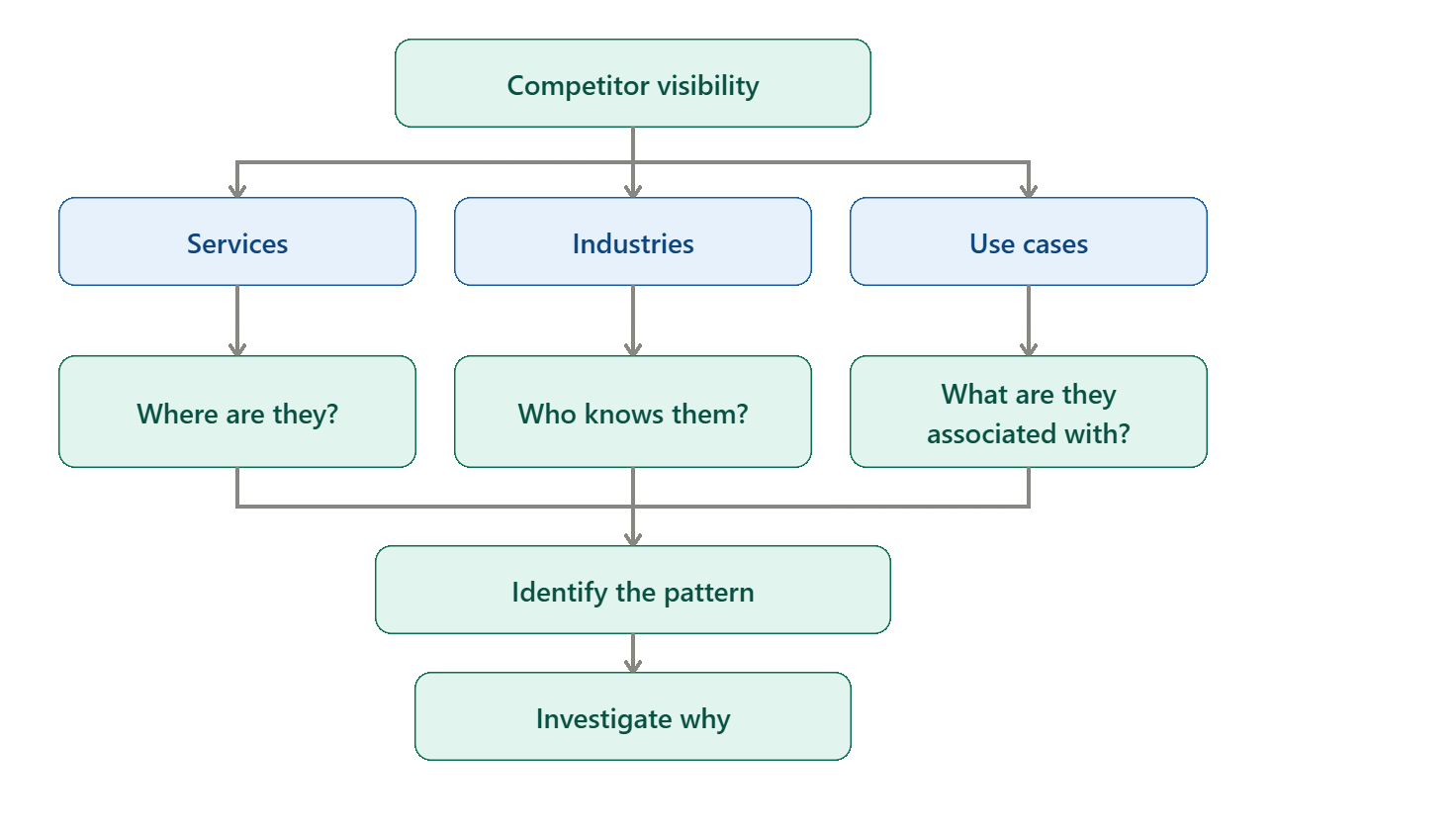
Suppose you test 25 questions. Your competitor appears in 15 responses, while your company appears in 4. That difference is worth investigating, but the numbers alone don't tell you why it exists. This isn't a universal AI visibility score. It is simply a sample you can use to identify patterns across the queries and platforms you tested. Look closer and categorize those appearances. You might find that those appearances cluster around:
- X times for industry-specific questions
- Y times for comparison questions
- Z times for local searches
Suddenly, the problem looks different: your company isn't broadly invisible. Perhaps you're simply less visible around certain topics or customer needs.
The goal is to identify the topics, industries, use cases, and customer needs where your competitor has a consistent visibility advantage.
4. Don't Rely on Generic Questions
Broad prompts can hide the real competitive picture. So, compare: Who are the best software development companies? with: Which software development company is best for building a healthcare platform? And which software development companies have experience building healthcare platforms with complex integrations? Each question introduces a different combination of intent, context, and requirements.
A company that doesn't appear for the broad question may appear for the more specific ones. That's why your research should include questions that reflect real customer needs, industries, projects, and buying decisions. Try to build question variations around industry, company size, location, product requirements, client problems, alternatives, compliance or regulations, and specific use cases.
5. Follow the Sources Behind the AI Answer
When a competitor appears in an AI response, don't stop at the recommendation. Look at where the information came from. If the platform provides citations or links, open them. The recommendation may be supported primarily by the competitor's website, or the answer may draw on external sources such as trade publications, review platforms, partner websites, interviews, comparison articles, or directories. This is why an AEO competitor analysis should examine the broader information ecosystem around each business, not just the two websites.
For example, a competitor may have a detailed service page, several case studies, a technology partner that mentions its work, and client reviews. Together, those sources create a much clearer picture of the company.
6. Compare What Their Website Makes Clear
Go back to the competitor's website. But don't just ask: "How can we make our website look like theirs?" Instead ask: "What does their website make immediately clear?"
Look at what a potential customer can understand during their first visit:
- What services do they provide?
- Who do they work with?
- Which industries do they serve?
- What problems do they solve?
- What types of projects do they handle?
- What makes them different?
- What evidence supports their claims?
Pay particular attention to specific information and evidence, not just promotional language. This might include case studies, credentials and certifications, customer examples, original research, expert commentary, relevant experience, technical resources, and industry recognition.
Then compare the information available about your company — not the number of pages on each website.
| Customer Need | Your Content | Competitor | Fill the Gap |
|---|---|---|---|
| Understand the service | Basic | Detailed | Explain the service better |
| See relevant experience | Limited | Strong | Add case studies |
| Understand industry expertise | Basic | Detailed | Create industry-specific content |
| Compare options | Limited | Strong | Add comparison content |
| Understand the process | Basic | Detailed | Explain your process |
| Evaluate technical expertise | Limited | Strong | Add useful technical information |
7. Look for the Associations Behind the Results
Don't just look at where your competitor appears. Look at what the internet consistently connects them with.
For example:
Competitor A
Company → Software Development → Healthcare Software → HIPAA → Integrations → Healthcare Case Studies
Your Company
Company → Software Development → Web Development → Mobile Apps
The difference isn't necessarily who has more content. It may be which business has clearer and more consistent associations with the customer's specific needs. In this example, your competitor may appear more frequently for healthcare software clientele, while you may appear more often for broader software development AI queries.
Your goal is to identify the associations your competitor has built and the ones your business may be missing.
8. Check Website's Technical Issues
Sometimes even high-quality content goes unnoticed by answer engines because of underlying website issues. Before diagnosing an AI competitor gap, check:
| Technical Area | What to Check |
|---|---|
| robots.txt | Are important pages accessible to relevant crawlers? |
| Indexability | Are important pages indexable? |
| Crawlability | Can crawlers discover and access important pages? |
| Canonicalization | Is the preferred version of each important page clear? |
| Structured data | Does your markup accurately describe the page and entity? |
| Content accessibility | Can important information be accessed without unnecessary barriers? |
| JavaScript | Is important content available in the rendered page? |
| Entity consistency | Is your business accurately and consistently described across sources? |
Confused about how to check these technical issues? Don't worry. AEO Digital can help you identify the underlying issues with a free audit and resolve them with targeted strategies.
Talk to a Technical AEO expert now
9. Don't Assume It's an SEO Problem
It is a big myth that SEO and AEO are the same thing. In truth, ranking #1 on SERP through SEO doesn't guarantee AI visibility. Both SEO and AEO complement each other but work on different mechanisms. If your competitor appears in AI answers, it doesn't mean the competitor has "better SEO." SEO certainly plays a role in discoverability, but the underlying difference lies in:
- More comprehensive coverage of a subject
- Clearer service positioning
- Stronger industry specialization
- More useful customer-facing explanations
- More independent mentions
- Better-developed case studies
- More consistent descriptions across platforms
- Greater brand recognition
- More relevant third-party references
- More evidence supporting its expertise
Therefore, diagnose the gap before fixing it. Diagnosing the gap first will help you invest in the right solution, whether that is improving content, clarifying positioning, strengthening evidence, or building relevant third-party visibility. If you want to win in this competitive landscape, traditional SEO won't cut it alone. Hire an SEO + AEO expert who can help you dominate SERP rankings and get recommended by AI platforms.
10. Build Your AI Competitor Gap Analysis
Once you've gathered enough evidence, turn it into an action plan. You can do this with a simple seven-step process.
- List your competitors: Start with the companies you already compete with. Add businesses that repeatedly appear in AI answers, even if they weren't previously on your competitive list.
- Build 20-30 realistic questions: Cover different intents rather than creating 30 variations of the same keyword.
- Test the questions: Test them across the AI platforms most relevant to your audience, and record the results consistently.
- Look for recurring competitors: Which businesses repeatedly appear? Which ones are associated with particular topics?
- Trace the sources: Record the websites, publications, reviews, directories, and other sources connected to those appearances.
- Compare your information and external presence: Look at what information exists about your company across the same categories.
- Prioritize the gaps: Decide whether the solution is better content, clearer positioning, stronger proof, or a broader online presence.
11. Match the Gap to the Right Solution
Not every gap deserves a new blog post. The right response depends on what the gap actually is and how you can fill it. The goal isn't to publish more. It's to provide the information your customers and AI systems are missing.
| Gap | Possible Action |
|---|---|
| Service is unclear | Improve the service page |
| Customer questions aren't answered | Create useful FAQ or educational content |
| Industry expertise is weak | Build industry-specific resources |
| Few project examples | Create case studies |
| Expertise isn't supported | Add evidence and expert content |
| Business information is inconsistent | Update important profiles |
| Few third-party mentions | Build relevant partnerships and PR |
| Customers need help comparing options | Create comparison content |
What If Your Website Is Already Better?
You may find that your website actually has more detailed information than your competitor. That's useful to know, but it doesn't mean the investigation is over. Look beyond your website and examine whether your competitor has stronger:
- Brand recognition
- Industry coverage
- Independent mentions
- Customer review presence
- Partner relationships
- Media exposure
- Established associations with a particular service, industry, or use case
- External evidence of expertise
A competitor can appear more consistently in your test set even when its website isn't objectively more comprehensive. That is why comparing the broader online presence matters.
The Goal Isn't Just to Appear on AI Platforms — It's to Become a Better Answer
When you discover that AI is recommending a competitor, don't immediately ask: "How do we get AI to mention us?" Start with: "Why does the competitor make sense as an answer to this question?" That small change in perspective can completely change your strategy.
You may find a content gap, a positioning problem, customers don't have enough information about a particular service, your expertise isn't well represented outside your own website, or several factors contribute to the difference.
Want to know why your competitors are appearing in AI Search? Our free AI visibility audit can uncover the questions, sources, and content gaps affecting how your brand appears across AI search platforms. Schedule a strategy call with AEO Digital.
