Why Ranking #1 on Google Doesn't Guarantee Appearing in AI Answers
August 24, 2026 · 11 min read · AEO Digital
Quick answer
Google rankings and AI visibility can overlap, but ranking #1 does not guarantee that your brand will appear in AI-generated answers. Google rankings measure a page's performance in traditional search, while AI visibility depends on whether AI systems retrieve, understand, trust, and use your content. SEO remains an important foundation for traditional ranking, but AEO adds another layer focused on content structure, entity clarity, technical accessibility, and supporting evidence across the web.
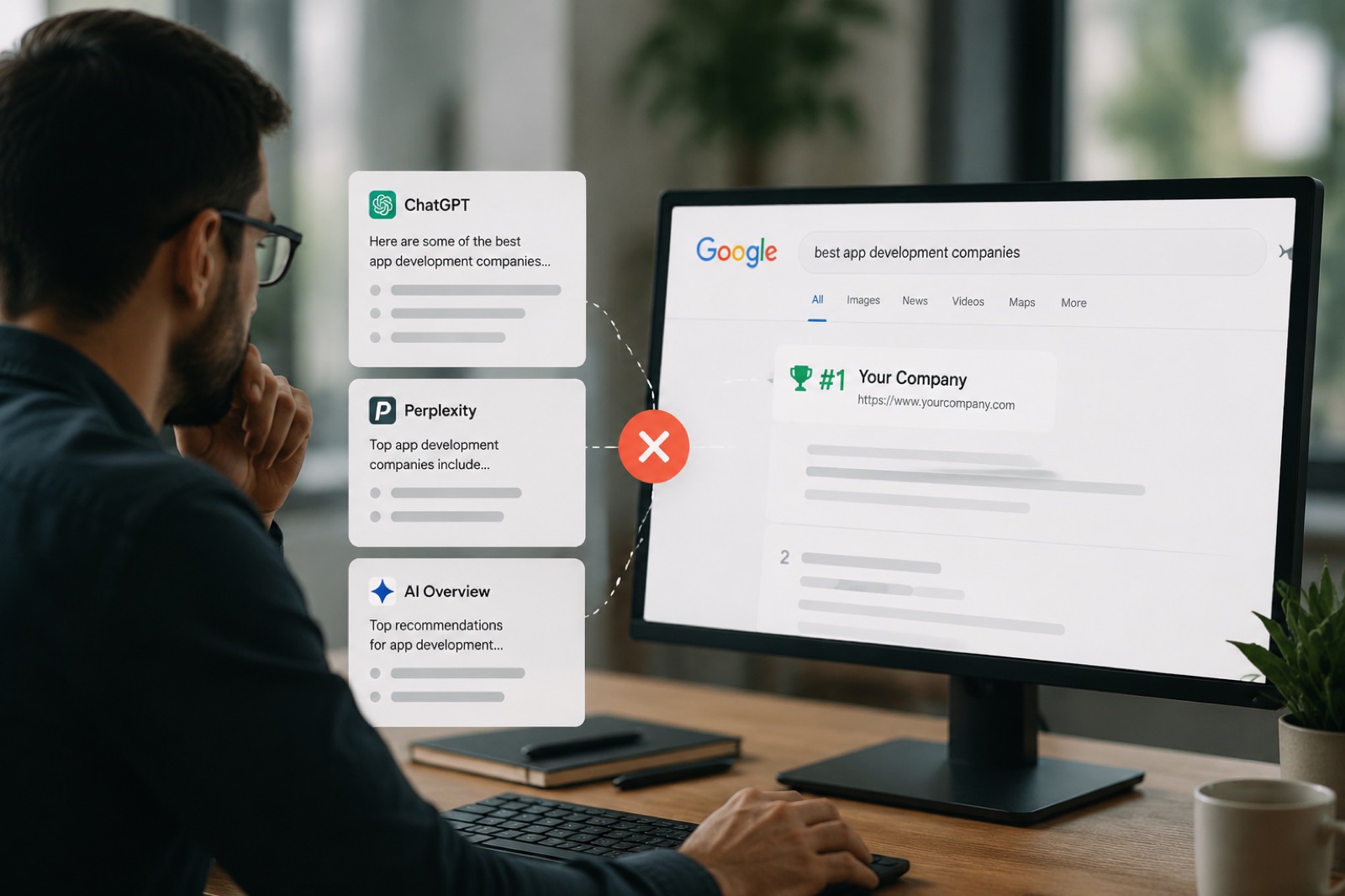
Your website ranks #1 for the keyword. Traffic is steady. Backlinks are solid. Your technical SEO checks every box a consultant would ask for. Then you open ChatGPT and type something a real customer would type: "What are the best companies for Apps Development?" Three business names come back. None of them is yours.
You check Perplexity — same result. You ask Google's AI Overview the same question in a slightly different way, and a competitor two spots below you on the actual search results page is the one being described as the top choice.
If you've run into this, here's what's really happening: Google and AI search engines evaluate pages differently. While Google checks a page for relevance, authority, and technical accessibility, AI engines assess content trustworthiness, extractability, entity clarity, and whether trusted sources support the information. The signals overlap, but AI engines diverge significantly on the dimensions that drive citations.
Let's explore why performing well in Google doesn't always mean appearing in AI answers in 2026, and how a targeted SEO + AEO strategy can help increase your chances of being mentioned and cited.
Google Ranking vs. AI Visibility: What Is the Core Difference?
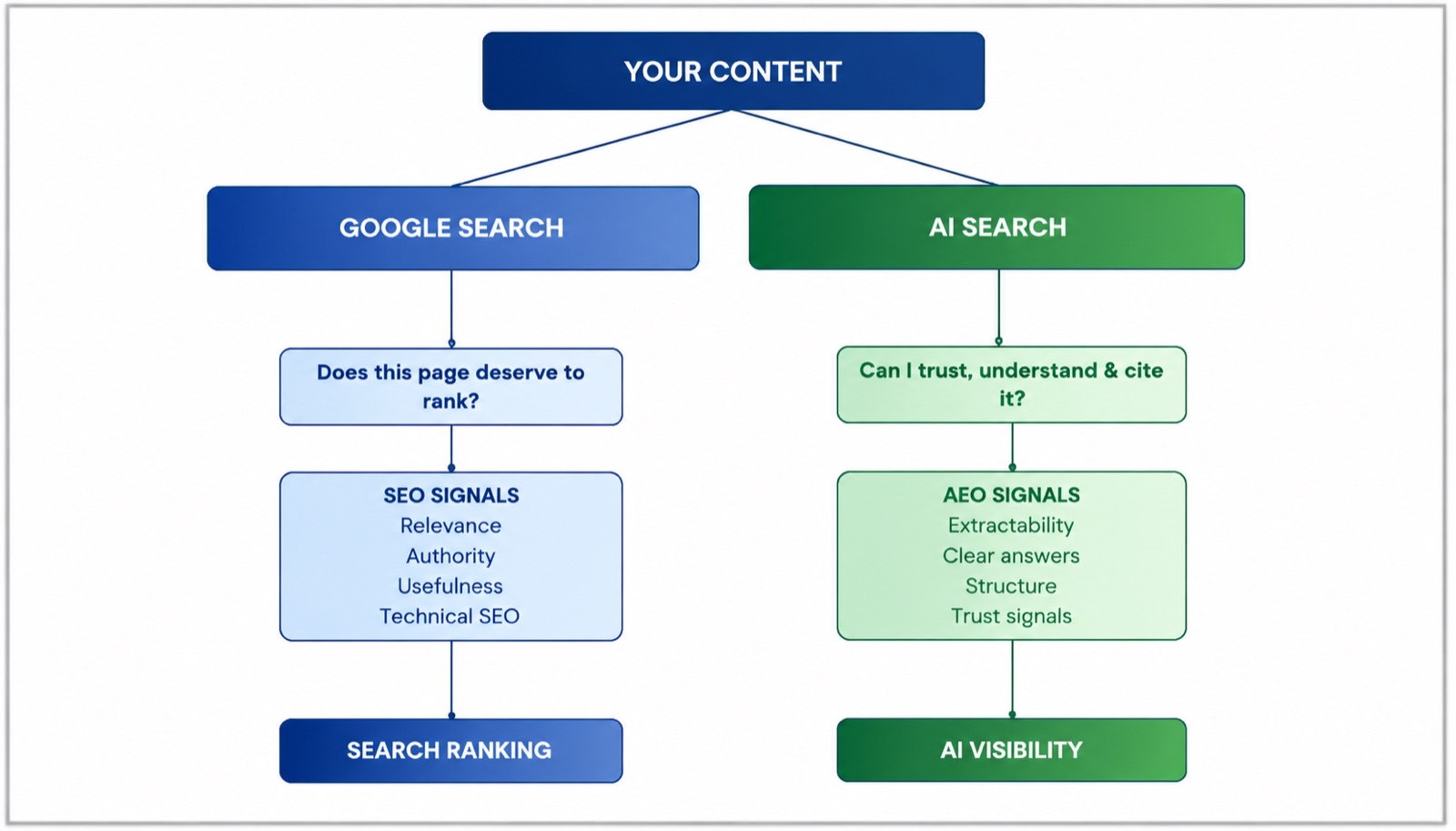
A Google ranking evaluates how relevant your page is for a specific query around your business. The site has enough authority and technical health to be trusted, and Google's algorithm decided you deserved a top position among competing results. It's a single website page evaluation against a single query.
An AI answer surfaces differently. When someone asks ChatGPT, Perplexity, or Google's AI Overview a question, the system isn't running a keyword match and handing back a list of links. It has to retrieve relevant content first, then select information using a combination of relevance, quality, authority, freshness, and other signals before generating an answer. Each step uses different signals than classic ranking does.
| What's Being Measured | Google Ranking | AI Overview / Chatbot Citation |
|---|---|---|
| Core question | Is this page relevant and authoritative for this query? | Is this brand a trustworthy, extractable source for this answer? |
| Primary signal | Backlinks, keyword match, technical health | Entity clarity, schema, third-party corroboration |
| Content shape rewarded | Comprehensive pages built to rank and hold attention | Self-contained, quotable, question-shaped passages |
| Trust built from | Mostly on-site and link-based signals | On-site signals plus mentions on Reddit, Quora, review sites, and publications |
| Consistency | One ranked list per query, largely stable | Varies by platform and even by how the question is phrased |
Google's classic system asks "does this page match the query well?" An AI system asks "do I trust this brand enough to put its name in front of a user as a recommendation?" One recent study by 5WPR's 2026 GEO vs. SEO research reports a substantial decline from roughly 70% to under 20% since early 2024 in the overlap between highly ranked Google results and URLs cited by AI platforms. Ahrefs research covering 15,000 queries found that only about 12% of URLs cited by AI tools also appear in Google's top 10 organic results, meaning most of what AI systems cite comes from pages that never make Google's first page. Two years ago, ranking #1 on Google was a reasonable proxy for AI visibility too. Today it isn't close to one.
5 Key Reasons a Top-Ranked Page Gets Totally Skipped by AI
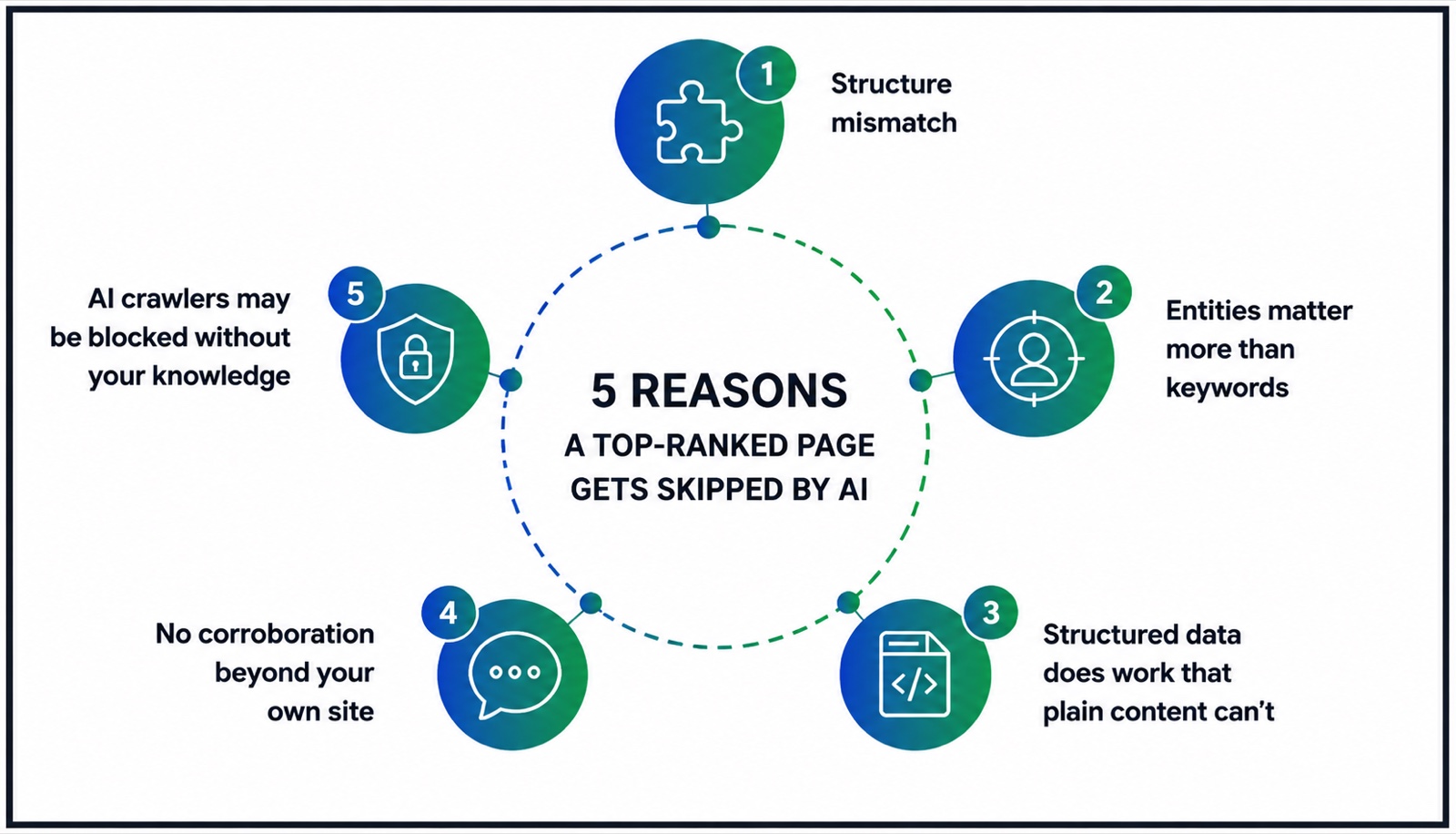
A page ranking at the top of Google can still be ignored by AI search engines because traditional search rankings and AI citations don't always follow the same signals. AI systems look for content that is easy to understand, clearly structured, well-supported, and connected to trusted information across the web. Here are five reasons a high-ranking page may still get skipped when AI generates an answer.
Structure mismatch
Pages built around long narrative paragraphs, written to keep a viewer scrolling, are harder for AI systems to extract from than pages organized around clear headers and direct answers. If an AI engine can't find a self-contained answer quickly, it moves to the next source.
Entities matter more than keywords
Google's classic algorithm leans heavily on keyword and link signals. AI systems place more emphasis on entities. They focus more on understanding who you are, what you offer, and how that connects to other trusted sources across the web. A business with strong rankings but an unclear entity footprint gives an AI system less to work with when it's deciding who to trust.
Structured data does work that plain content can't
Schema markup gives search engines structured information about your organization, content, products, services, and other entities. It can reduce ambiguity and help systems interpret page information, although schema alone does not guarantee AI visibility or citations. Need help implementing structured data? Try AEO Digital's Free Schema Markup Generator.
No corroboration beyond your own site
Google rankings are largely a judgment about your page. AI answers often draw on a broader picture, including how you're discussed on Reddit, Quora, review sites, and industry publications. A brand that ranks well but has almost no independent footprint elsewhere online can look, from an AI system's perspective, like a brand nobody else is talking about.
AI crawlers may be blocked without your knowledge
If an AI crawler cannot access a page or domain, that crawler may not be able to retrieve the content for systems that rely on that access. Check your robots.txt configuration before assuming content quality is the problem.
How to Test Your AI Search Visibility
The easiest way to understand your AI visibility is to search as your customers do.
Open ChatGPT, Perplexity, or Google AI Overviews and ask the questions your potential customers would actually ask. Don't just check whether your brand appears in the search; look at whether AI mentions your business, cites your website, and which competitors appear instead.
Run these tests across several important questions, because AI visibility can change from one query to another. Being recommended for one search doesn't mean you'll appear for every related question.
If you want a faster way to understand where your website stands, our free AEO Audit Tool can analyze the key factors that influence AI visibility. This tool gives a full report on your website's AI readiness by analysing AI crawler accessibility, content structure, entity signals, citation potential, schema, and technical performance issues.
Generate My Free AI Readiness Report
Most Common AI Visibility Issues and How to Solve Them
An AI visibility gap isn't always caused by a failing AEO strategy. The real reason could be your content, entity signals, topical coverage, freshness, or technical accessibility. Once you identify the problem, you can fix the specific gap instead of changing everything at once.
| If You Notice | Likely Reason | What to Do |
|---|---|---|
| Your brand never appears on AI overview or LLMs | Weak brand/entity signals | Strengthen your company and brand information on landing pages |
| Your brand is mentioned but not cited | Your website isn't a strong supporting source | Improve relevant content and add supporting evidence |
| A competitor is cited instead | Their content better matches the question | Compare their content, depth, and relevance |
| You appear for some questions but not others | Your content doesn't cover enough customer questions | Create content around important customer queries |
| AI uses outdated information about you | Your website or third-party information is outdated | Review and update important business information |
| AI misunderstands what your company does | Your entity information isn't clear | Improve your About, service, industry, and location pages |
| Your website rarely appears as a source | Content may be difficult to retrieve or access | Check crawlability, robots.txt, and technical accessibility. Use AEO Digital's Free Broken Link Checker to find links that need attention. |
AEO Checklist to Optimize Your Website for AI Search
Optimizing for AI search means making your website easier for answer engines to interpret, retrieve, verify, and use. It means adding a second layer to the SEO work you have already done.
- Build content for answers, not just rankings. Content still matters. Provide the context AI systems may need to understand your business. The goal is to make your expertise clear, useful, consistent, and easy to verify.
- Strengthen your website's AI readability. Create clear, well-structured, and trustworthy content that both users and AI systems can understand easily. Start by making your website's key information easy to find and interpret.
- Keep your meta information fresh. Your meta descriptions communicate what each page is about in search results. If you need to refresh them, AEO Digital's Free AI Meta Description Generator can help you create clear and relevant descriptions faster.
- Rewrite key pages around the actual questions customers ask. Map important pages to the questions customers ask before choosing a provider, such as pricing, implementation, industry experience, and suitability for different business sizes. Put the direct answer near the top, then explain your services, process, experience, and results.
- Add structured data that spells things out. Use schema to help AI systems understand who you are and what you offer. Create service, Article, and FAQ schema to make important information easier to identify and extract.
- Build a footprint beyond your own domain. Relevant third-party discussions, reviews, publications, directories, and community sources can provide additional context about a brand. Their value depends on the source, relevance, credibility, and quality of the information being discussed.
- Confirm AI crawlers can actually reach your site. Check your robots.txt file for GPTBot, PerplexityBot, and Google-Extended, and confirm none of them are blocked. Use AEO Digital's Free Robots.txt Generator to create or review a properly structured file.
Case Studies: What Closing the AI Visibility Gap Looks Like
We didn't get this information just from online resources. We've worked in this field for more than 15 years and have hands-on experience boosting online visibility of businesses. Our AEO approach combines proven SEO fundamentals with AI-focused optimization, including structured content, entity clarity, technical improvements, and authority signals beyond the website. We have helped countless businesses improve their visibility across search engines, AI overviews, and large language models by building stronger content strategies, technical foundations, and authority signals.
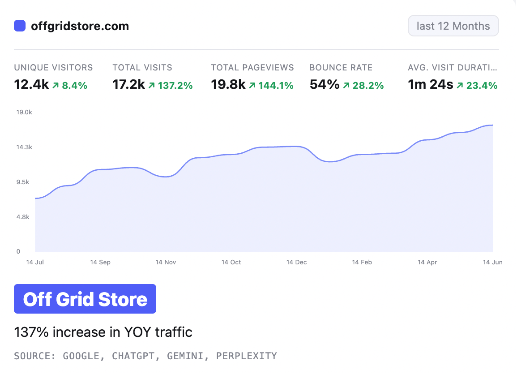
Off Grid Store
We helped Off Grid Store strengthen its visibility across traditional and AI-driven search. Over the last 12 months, traffic increased 137% year over year, reaching 17.2K total visits and 19.8K pageviews.
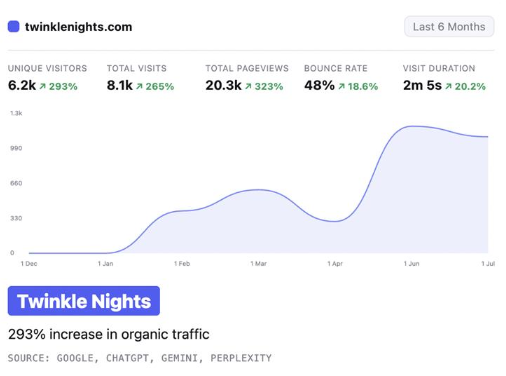
Twinkle Nights
Our targeted AEO strategy helped Twinkle Nights strengthen its visibility across traditional and AI-driven search. Over the last six months, the brand recorded a 293% increase in organic traffic, with 6.2K unique visitors, 8.1K total visits, and 20.3K pageviews.
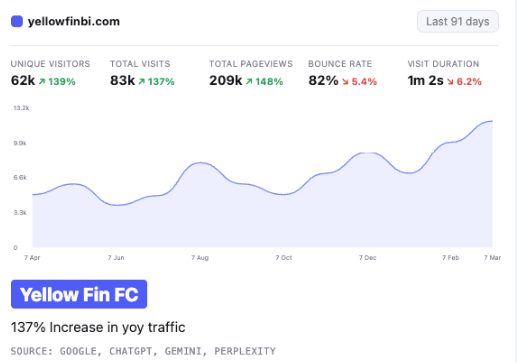
YellowFin BI
We helped YellowFin BI expand its visibility across traditional and AI-driven search. Over the last 91 days, the brand recorded a 137% increase in organic traffic, with 62K unique visitors, 83K total visits, and 209K pageviews.
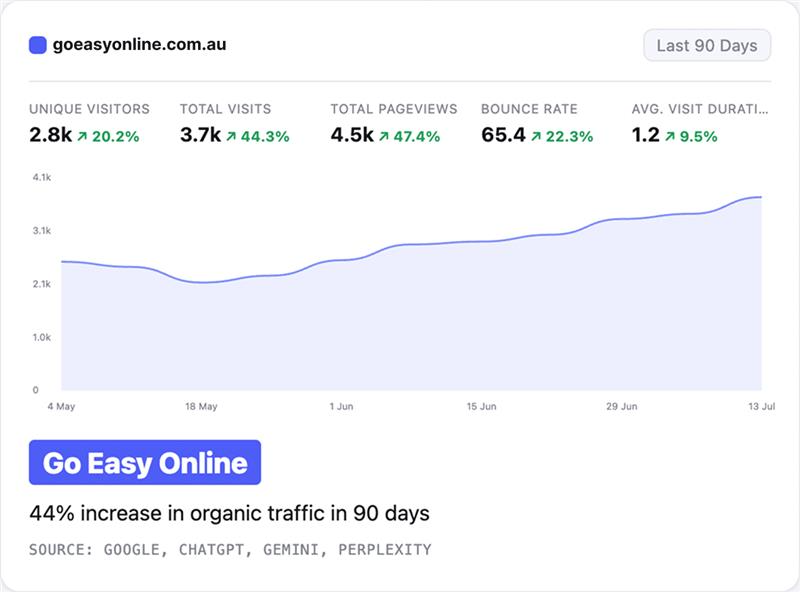
Go Easy Online
AEO Digital helped GO Easy Online strengthen performance across both traditional search and AI-powered platforms. In the last 90 days, the brand saw a 44% rise in organic traffic, reaching 2.8K unique visitors, 3.7K total visits, and 4.5K pageviews.
Ready to Get Cited by AI?
A strong Google position gives you a valuable foundation on search engines. The next step is making that foundation useful to AI systems by strengthening the content, entities, technical signals, and external evidence they can evaluate.
If you're ranking well and still not seeing your brand in AI Overviews, ChatGPT, Perplexity, or other LLM models, that gap is exactly where AEO Digital can help. Our dedicated SEO + AEO services restructure your content around the questions AI systems are actually trying to answer, including the schema and entity foundation that helps AI platforms recognize, trust, and cite your brand with confidence.
If you want to see exactly where that gap is costing you, schedule an AEO Digital Strategy call with us. With our AEO growth plans, you get a complete strategy covering AI visibility, technical optimization, authority building, and 30% guaranteed organic growth in six months.
